Part beat on a global binge, whose fix is travel and experience; part student learning art and culture, history and language; and part citizen finding his place and duty of universal respect in our global community.

Monday, September 29, 2008

Mists of Delphi

Grey outside. Misting precipitation clinging to the sweater I have just put on--put on for the first time since arriving in Greece. The weather and the mountainous terrain set Delphi apart from Athens. The dreariness isn’t the only difference from Athens; but it might be to blame for the otherworldly feeling I get walking through the steep streets of Delphi. I can only imagine the many mile long treks from Athens or Sparta or Corinth or any of the ancient Greek city states along mule paths clinging to steep ravines as delegates make their way to offer at the Temple of the Pithian Apollo or ask advice and guidance from the famed Oracle. It is easy to imagine the affect of unearthliness that marbled pillars and temples and statues rising with a polished white sheen out of the rough rock and breaking the seemingly omnipresent fog and mist would have on the wearied traveler already expecting to commune with the gods.
(Wrestling at the anceint Delphic gymnasium+foreboding skies and heady scenery)
With the rain falling in a much more pressing manner, we leave our bags at the hotel and walk to the Archeological museum; saving the onsite walk for a dryer day. Our hotel is situated on the lowest of the four parallel streets that are cut into the mountain side and make up modern Delphi; and our room is on the lowest level with a balcony big enough for the three of us to stand on and gape at the river valley opening below like an open mouth exposing gums and cheeks of olive trees and lush green vegetation and teeth of white rock accentuating the color of green that marches unbroken from the valley immediately below to the glistening bay of Corinth that sparkles in our eyes while we drink in the entirety of an impressive sight. Again, it is easy to understand how the ancients looked upon Delphi as holy ground. (Outside our hotel room and view below)
The ruins of Delphi itself are impressive, but are incapable of arousing the awe inspired dedications and pilgrimages that marked its earlier history. While the building structures themselves have, for the most part, been lost to the mists of times that swirl constantly around that mountain peak, the overall plan of the city is easily recognizable. Narrow streets winding upwards along the mountainside with avenues packed full of the Treasuries of various Greek powers and temples and statues and monuments that are sometimes built to crowd the monuments of other powers after recent military victories; a kind of religious/military one up manship. The sacred streams of the Pithian Apollo still trickle down from the rocks above; while priests and pilgrims from around the Aegean world bathed in the holy waters, it was only fitting that I rinse my beard in its cleansing waters.
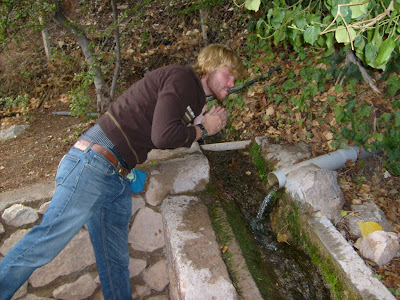
Sam felt an overwhelming urge and falling on his knees demanded and begged for a spontaneous baptism into the pantheon of Greek Gods and giving his suppliance and devotion to Apollo in particular; I could do nothing but humbly comply (I was bathed in the waters of Pithian Apollo and as such was as near to an Apollonian Priest as we had) and quench his burning desire with a couple handfuls of the holy water that had flowed for ages over the now worn and smooth rocks, ethcing into the rock a timless legacy of its ancient tradition and importance.
It should be noted that since my ordination and Sam's baptism we have had eerie instances of foresight and prophecy. So, as the nations of Greece used to go to the Oracle for political, social and military advice; I suggest that the nations of the World might find some useful (and divinely inspired) suggestions from us. Thanks Apollo.

Thursday, September 25, 2008

Fresh Fruit

Whole fish and local catch sit in beds of ice swiftly melting in the early afternoon sun glaring heavily and unhindered despite narrow streets and vendor’s awnings. The distinct aroma of fish, pungent as they bake in the sunlight releasing odors better suited for the shores of harbors and seas rather than the cobblestone streets of Pangratti’s local farmers market. Old men whose beards are starkly white, pebbled along ancient cheek bones long ago stained a beautiful olive brown by the incessant and inescapable Mediterranean sun sitting at small tables. The old men seem as permanent fixtures in all spots of local flavor. It is like moss growing on the north side of a tree; if there are old Greek men discoursing or playing backgammon then I know I am in a ‘Greek’ place. Gnarled and weather worn hands deftly sort through the mosaic of fresh vegetable and fruits; my eyes follow their movements as they fill bags with peppers, grapes, olives, onions, eggs, and tomatoes and countless other delicious organic treats. Placed between cornucopic displays of green and red grapes of varying sizes are bottles of the growers own wine. And between the bowls of olives—more types and shapes and colors of olives than I could have imagined—rests the farmers freshly squeezed olive oil; a necessity for cooking and a tantalizing novel and delicious delight. With arms weary and sagging by the weight of our newly acquired profusion of produce, Sam and I leave the steep hill and narrow street of the market. Not the fresh wine whose origin sits nestled on the vine that was sold at the market, rather the cheap table wines of local creation serve as our lubricant for the evening, as with most evenings. Tony and Sam passing the guitar between themselves while I huff away at a harmonica and our other flat-mates listen with loose and appreciative motions and an occasional freestyle verse. The song ends and I excuse myself to search for sustenance. A search I remember excitingly that will yield bountiful results. I slice one of the tomatoes, its deep red color leaving me expecting blood to squirt. The first bite doesn’t disappoint and I am intrigued about how the produce, all of it, seems more vibrant in taste. The uniformity and aesthetic appearance of American crops is strikingly missing; the tomato under my culinary scalpel has an odd shape so that it only lies on its side. The local farmers have opted out of cookie cut genetic engineered veggies and instead offer a product of superior quality, flavor, taste and even (in the two weeks I’ve been able to observe) shelf life. Back to the tomato though, a dash of salt and I know that I have found my staple diet while I stay in Athens. I was not content with one tomato so I slice two more and laying them in a bed of the freshly squeezed olive oil I sprinkle salt and pepper. With bread in hand I carry my simpleton feast to my friends. If the tomatoes were not amazing enough on their own, the olive oil adds a depth to the flavor and a level of complexity that pleasures the taste buds with caressing touches of oil and juicy tomato until the climax is reached when a slice of bread, thoroughly sopped with oil is adorned with a final slice of tomato and with flourish like an artist’s brush strokes salt is sprinkled affectionately on top… Today is our last day in Athens for a while; we are leaving for Crete tomorrow. Homework has been piled on and preparations and anxiety is mounting. Having finished what I can this evening (including this blog) and having re-read my words, I can think of nothing more fitting than to sate myself with one last tomato.

Friday, September 19, 2008

Hair

Andreas, our neighbor and hairdresser, has been a great friend and resource as we get settled into Athens. Explaining good places to eat and clubs to go to while filling our glasses with wine or birre. Our acquaintance began with his desire to sculpt my hair. Here is the fruition of his passion.

Passing Days in Athens

Academics and learning, academics and learning, academics and…. I have to repeat it and remind myself that I still need to be in classes and I still have books to read. I try and set my mind into the rigorous mindset of schoolwork and schedule. But my classes themselves are as much to blame for the undefeatable feeling of vacation as any thing else. Our first history class took us through the Plaka and past the Acropolis to the top of Philopappos Hill for an unobstructed view of the Attican Valley and the port of Piraeus and the many temples snuggled around the Acropolis. Our next class, art history, was a walking tour through the Dark age, Orientalizing, and Archaic periods of Greek art at the National Archeological Museum; a location that will serve, every Wednesday, as our classroom. After classes, if we don’t jump right into a siesta, a group of guys will head to the basketball courts to play around. In the intense midday heat of Athens, we can get a great workout and sometimes compete against local boys, games which can get competitive and we bump and scuffle hard against the Greeks but both parties enjoy the game. Other days, I head to the hill that the Marble Stadium (of the 1896 opening games) is built into and start running on the track set along and hidden by the uppermost seats of the stadium. Local men run through the shade that the trees hanging over the track offer, or do pull ups and climb rope ladders on the outdoor equipment. An oasis, a truly local spot where I can train like a Greek Olympian of yore (although clothed) on track and simple machines while also hoping to bronze my pale Irish complexion. And coming home from an exhilarating run, breathless from the exertion and the sight and atmosphere that the track lends, I climb through our kitchen window and make my way up steel staircase to the roof of our building. The odors of Phil’s cooking (making true to his promise) are still in my nose promising a delicious feast to come. A glass of Greek wine—procured from a merchant on our street who fills the big plastic jugs directly from wooden barrels—sits in my hand having been stuck there by Phil with a smile and a ‘bloody hell, here drink this’. I can see Buddha, Andreas’ dog, prowling around outside his salon and then pissing on a street corner. I can see the Parthenon and Lykabettos Hill, like green and rock megaliths breaking the white housed sea continuum of Athens. I see solar panels on every rooftop. I hear the church’s bells chiming again and the cool breeze rustling my hair. The sights and sounds plus the refreshing offering to Dionysus clutter my sensory platter. But like the omnipresent rays of the sun, its setting overpowers everything else and I find myself breathless again.

Salt of the Earth

The travel guitar, ¾ sized for easy transport into Europe, rests on Sam’s knee, quiet a moment. Jamming with trashcan percussion, harmonica and guitar to Sam’s limited repertoire of sing alongs; the incessant honking of Turkish drivers laying on their horns even in the late night breaks the momentary silence through the open window of our eight person hostel dorm room. Andrew and Madeline take the moment to say good night and head down the hall for the evening. Two German students traveling together through Istanbul befriended us with broken English and so we stayed up that first night smoking apple rose nargile and learning playing backgammon and sipping the cider rich apple cay between hands of cards, the live music of local instruments keeping spirits and energy high late into the night. We arose and with warm embraces parted way as Madeline was heading next to Ethiopia and Andrew into Berlin. Ukraine’s finest tri-athlete, Daniel, spoke up next suggesting a cigarette. Watching as the smoke hung heavy on my friends' lips and slowly dissipated into the humid sticky evening air or clouded around the single bright bare bulb lighting our room I had to laugh as I remembered Daniel’s farcical swimming cap and ‘leave nothing to the imagination’ skin liberating Speedo. Each bare chest however, catching judging glances from passerbyer’s in this modest Islamic country. No shame in Danny’s eyes stripping to near nothing; the same self assuredness apparent as he refuses to get in ‘dis cold water, I get a cold and sick is bad for triathlon in Tarsus’ and so lights another cigaro to pass the time while we swim. Danny’s boisterousness was offset by the wonderful food he had made and packed from Kiev, and we were glad to have him in our crew for the eccentric flavor it added. With the nights last song enjoyed I entered into attempted discourse with Vincent from Boudreaux concerning subjective and objective reality and its bearing on the meaning of human existence. Phil, the Australian chef drifter, offering his own simple philosophies to the discussion in an English more indecipherable (albeit suffering from his philosophy of choice for the evening, ‘why not have a beer, when you can have a beer?’) then the Frenchman’s. (Mismatched pack of Vagrants) Fitting, that in a city of cultural crossroads our comrades come from diverse lands. Epitomizing the character of easy going, our new friends have proven to be invaluable aspects of truly enjoying and experiencing our travels. Good bye’s said—although not in actuality; a Canadian named Andrew meshing into our small group of American students for the trip to Athens, and plans made for Phil to stay and cook fine and real dinners for us on his way through Athens—we commenced our arduous journey to Athens.
(Turkey waving goodbye)

Monday, September 15, 2008

The daughter of Zeus and Metis

The daughter of Zeus and Métis, Athena is heralded as the Goddess of Wisdom and is the particular patron god of Athens. Athenians at one time were held captive by the Minoans of Crete in which fourteen virgin teens were sent to their death at the hands of the Minotaur in the inescapable darkness of the Labyrinth. That is, until Theseus killed the Minotaur. Returning triumphant however, Theseus forgot to have his sail changed from black to white and so his father, King Aegius, threw himself from the topmost cliff into the frothing white ocean giving forever his name to that sea. The Acropolis and its many monuments were constructed over four centuries before Christ taught logos in Galilee. Socrates, Aristotle, Anaxagoras, Stoics and Platonists discoursed about the role of virtue and civic duty in a functioning representative democracy two millennia before Jefferson and company created American democracy. (Later to be recreated into an oligarchy of powerful business conglomerates faintly presented with the façade of a free and democratic country). When the Parthenon was destroyed in the 17th century, our nation’s oldest landmarks were just being built or settled. Riding a tramway built by a Ferrari engineer zooming through the streets of industrial and modern Athens, enjoying the flooding cool breeze of the God Freon, watching as mobile phones ring with music tones of hip hop or American rock and the Athenians pulling out MP3 headphones to answer curtly “Ne?” I have been stopped by a nearby hairstylist, Andreas, who wants to dye and style my hair as part of a professional Vidal Sassoon campaign. I have been able to sit in the shadows of the acropolis and connect to high-speed internet. Athens is a modern city and one where the amenities and lifestyles of New York City could be found, albeit with a much richer, Mediterranean flavor. Before browsing through the weekend open air farmers market I walk through the McDonald’s waiting area causing me pause to contemplate whether the juicy, red tomatoes I got in the market and have been eating like candy since, are the same that this globalized mega-giant uses (more likely their tomatoes are packaged and frozen tomatoes from the genetic bred and chemical choked fields of The American Heartland). The modern Metro shoots commuters or tourists or lost adventuring college students quickly through stone veins to the many heads and limbs of Athens. Adorning the walls of the Metro are the ancient remains uncovered during the tunnels’ construction. In vogue, trendy nightclubs the floors are glass portals, allowing dancing youths to peer at ancient ruins many meters below; and so, into their cities rich history hundreds of generations past. Contrast has the beauty of achieving many things; the contrast of old and new brings clarity about what Athens is to Athenians, the real Athens. Athens cannot be new and modern; it cannot be the city of Greek Antiquity either. For good or worse Athens is not an amalgamation of old and new, it is both. A dictum which is familiar to my ears but whose lesson is different every day: things are never one or the other, never black or white. It isn’t grey either; life shows that we live in a precarious state of dualism, suspended between what we know and recognize about the world and ourselves, and all of the things we might want to deny or forget. We are neither one nor the other, as humans we embody extremes. A lesson in human dualism engrained in my mind by the sleek steel buildings built over the glistening white marble of ancient Athens. Through the mists of time via millennia of philosophers the words of an ancient Athenian (Aristotle explains virtue as living a life with an appropriate balance between those extremes) explains how I might take to heart that lesson. What then, is the balance between Greek gyro souvlaki and Greek wine? I'm not sure yet, but plenty of hands on experimentation will likely lead to a solution.

Thursday, September 11, 2008

Lykabettos Hill

Six people found living in athens
Four rooms, couch and kitchen too
Three balconies to breathe a breeze
A simple enough equation. Its constituent parts are few and recordable now. But this is no static math problem and its outcome is entirely unknown bar one easy rule: with each passing day experience and learning increase exponentially.
Classroom views of the Parthenon and neighbors to the olympic Stadium of 1896, the first in the modern era. Exploring the area yielded a discovery I hope to make use of time and time again. A minimal feel supplies entrance to a tram system that, in thirty short minutes, depoisited Sam and I on the first beach shores of our trip. I envision after class excursions to enjoy, reading and studying, lounging tanning and swimming on a different Athenian beaches, observing the locals and tourists alike as no doubt they observe the freckled bodies and habits of myself.
With move in out of the way and introductions passed, the task of establishing some semblance of a routine has become an important task. This in mind, roommates gathered, shoes strapped firmly on our feet, we set out on a mid-evening jog. On the top of Lykabettos Hill, the highest hill in Athens, sits the small Orthodox Church of St. George; it was this church that was our destination. A mighty trek up winding staircases and steep hillside, first through homes and shops and reaching higher running past the local flora dotting the hillside and finally struggling past the cafes clinging to the rock approaching Lykabettos' summit. Sweating and panting from the effort of 266 vertical meters my friends and I glady sat for a break and turned my head to drink deep a sight I don't yet have words for...